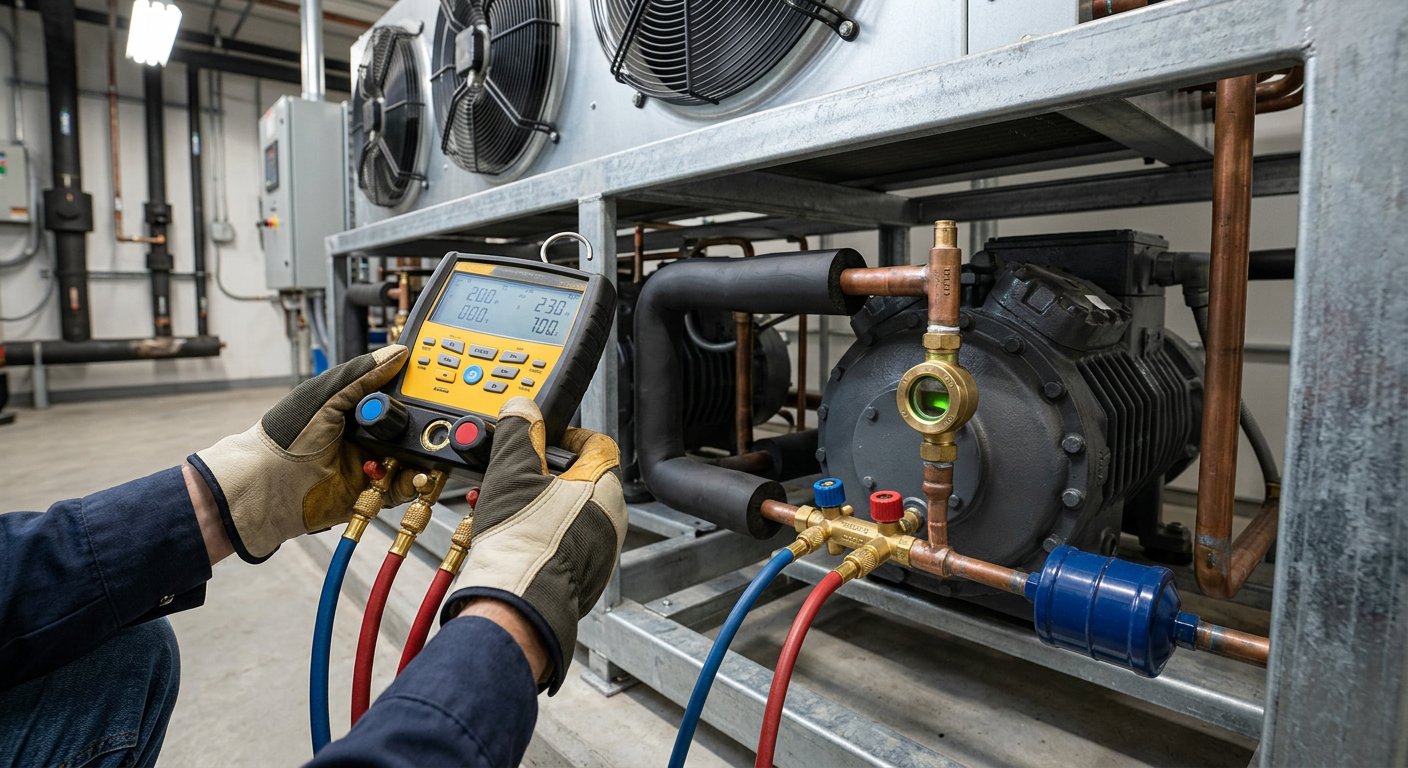
Why “Topping Up Gas” Damages Your Cold Room
Many commercial refrigerants used in Ras Al Khaimah—such as R404A, R407F, R448A and R449A—are blended zeotropic mixtures made of multiple gases with different boiling points. When a leak occurs, the lighter components escape faster than the heavier ones, changing the blend composition (glide fractionation).
Blindly adding gas on top of an unbalanced, leaking charge reduces cooling efficiency, risks moisture ingress into the oil, and guarantees another breakdown.
Our 5-Stage Leak Diagnosis & Permanent Repair Protocol
- Visual Oil-Trace Inspection: Refrigerant carries microscopic compressor oil around the circuit. Where gas escapes, oil leaves a tell-tale dark sheen on copper U-bends, flare nuts, TXV bodies or Schrader valves.
- Heated-Diode / Infrared Electronic Sniffing: Probing low-velocity air pockets inside the evaporator casing, condensing deck and pipe joints down to a few grams-per-year sensitivity.
- Oxygen-Free Dry Nitrogen (OFN) Pressure Testing: Pressurising the isolated circuit safely with dry nitrogen and micro-bubble solution to expose hairline vibration cracks under realistic operating pressure.
- Nitrogen-Purged Silver Brazing & Valve Replacement: Brazing copper repairs while flowing low-pressure nitrogen inside the pipe prevents black copper-oxide scale from forming and clogging your expansion valve.
- Filter Drier Swap, Micron Vacuum & Weighed Charge: Installing a fresh liquid-line filter drier, evacuating moisture with a deep two-stage vacuum pump, and weighing in pure refrigerant.
Need permanent leak resolution anywhere in RAK? Visit Cold Room Refrigerant Leak Repair or review pricing factors in our Cold Room Repair Cost Guide.